
The International Symposium on CAMPUS Asia Common Quality Assurance Standards Project
This symposium has ended.
The International Symposium on
CAMPUS Asia Common Quality Assurance Standards Project
Inter-University Exchange Project by Ministry of Education,
Culture, Sports, Science and Technology (MEXT) of Japan
"Quality Assurance of Cross-border Higher Education:
Sharing Practices, Perspectives, and Regional Approaches"
Tuesday, November 4th, 2025
2:00pm - 5:30pm JST (5:00am - 8:30am GMT)
Join ONLINE or IN-PERSON at the National Center of Sciences Building, Tokyo
Japanese-English simultaneous interpretation available
Organizer:
National Institution for Academic Degrees and Quality Enhancement of Higher Education (NIAD-QE)
Overview
Under the CAMPUS Asia Common Quality Assurance Standards Project, NIAD-QE has been developing the “Common Quality Assurance Standards” collaboratively with the Education Quality Evaluation Agency of the Ministry of Education (EQEA, China) and the Korean Council for University Education (KCUE, Korea) since 2021 to support sustainable quality assurance efforts by university consortiums across Asian countries and enhance quality-assured inter-university exchanges and student exchange within the region. The “Standards” were finalized in April 2025, and will be disseminated as project outcome at this symposium, with the theme of “Quality Assurance of Cross-border Higher Education: Sharing Practices, Perspectives, and Regional Approaches.”
In quality assurance of cross-border higher education (CBHE), it is important to understand and respect differences in national and regional contexts, as well as the elements they value while forming a common understanding of quality among the systems and institutions involved. Transparency is also an essential factor in quality assurance.
This symposium also focuses on quality assurance in CBHE, particularly in international joint programs, and introduces the latest practices of policies in Asia and Europe, which is advancing in this field, as well as initiatives by the Campus Asia Consortium and the “European University” consortium, a cross-border university consortium within Europe. Additionally, the symposium highlights the content of the “Common Quality Assurance Standards” and discuss what constitutes quality inter-university exchange programs.
This symposium will be an opportunity to explore and deepen understanding of the perspectives, practices, and approaches to quality assurance in such programs and contribute to the further enhancement of the quality of international inter-university exchange programs in Asia.
NIAD-QE Seminar will be held the following day on Wednesday, November 5th, 2025 (9:30am-12:00pm JST / 0:30am-3:00am GMT,) inviting one of the symposium speakers, Mr. Douglas Blackstock, Former President of The European Association for Quality Assurance in Higher Education (ENQA)*as of the symposium date, to further discuss the quality inter-university exchange programs while particularly referring to quality assurance approach and recent activities in Europe.
Program & Materials
| 14:00-14:05 | Opening Address HATTORI Yasunao: President, NIAD-QE HATTORI Yasunao: President, NIAD-QE |
| 14:05-14:10 | Welcome speech SATO Kuniaki: Director, International Affairs Division, Higher Education Bureau, MEXT |
| 14:10-14:40 | SUGIMURA Miki: President, Sophia University/ Professor, Faculty of Human Sciences, Sophia University "Advancing International Higher Education in Asia: Functions and Implications of Common Quality Assurance Standards" |
| 14:40-15:05 |
NISHIZAKI Hiromitsu: Professor and Director, Center for Promotion of Internationalization, University of Yamanashi "Initiatives of Internal Quality Assurance in the "Asia Real Problem Solving- Driven AI Education Program" in Partnership with Four Asian Universities" |
| 15:05-15:25 | Refreshment Break & Networking |
| 15:25-15:55 |
Douglas Blackstock: Former President, The European Association for Quality Assurance in Higher Education (ENQA) "Quality assurance: building trust and confidence in Cross Border Higher Education, a perspective from Europe" |
| 15:55-16:20 |
Margot Van den Broeck: Policy Advisor, Educational Policy Department, KU Leuven (Catholic University of Leuven) [Online presentation] "Shaping the umbrella. Una Europa's internal quality assurance process for joint education" |
| 16:20-16:50 |
Dongseok Seo: Senior Director, Office of University Innovation Support, KCUE LUO Xiong: University of Science and Technology Beijing [Online presentation] HOTTA Taiji: Research Department, NIAD-QE "Developing the Common Quality Assurance Standards" |
| 16:50-17:00 | Refreshment Break |
| 17:00-17:25 | Panel Discussion |
| 17:25-17:30 | Closing Remarks MITSUISHI Mamoru: Vice President, NIAD-QE |
| 17:30 | End of the Symposium |
This symposium has ended.
Thank you for your attendance and participation.
Photos
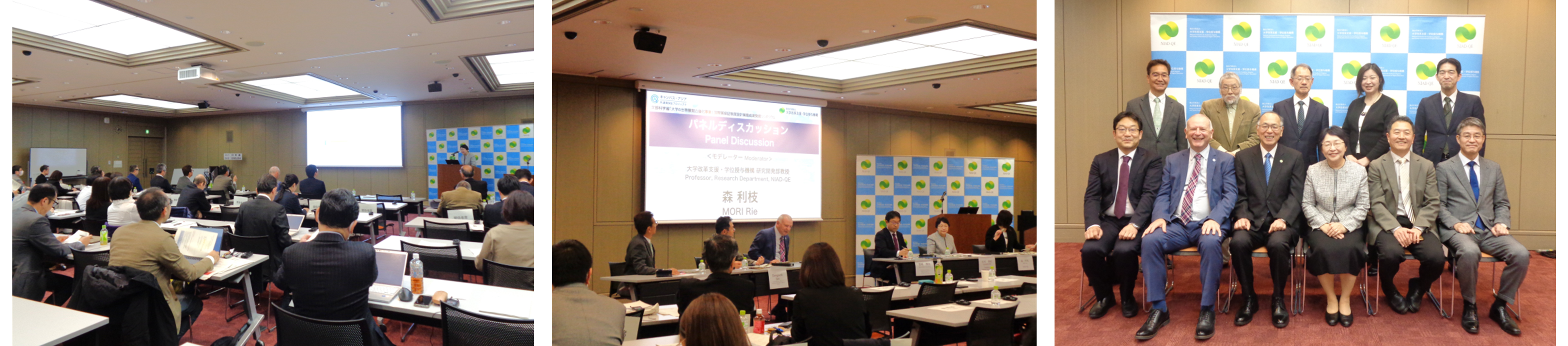
Symposium Venue Panel Discussion Speakers and NIAD-QE executives group photo
Recording
The recording has expired.
Report
NIAD-QE hosted the symposium under the theme of “Quality Assurance of Cross-border Higher Education: Sharing Practices, Perspectives, and Regional Approaches.
Professor Sugimura introduced trends in international higher education in Asia and the importance of quality assurance in cross-border higher education. She first underlined key principles that could be challenging to quality assurance for inter-university exchanges in Asia:diversity as a foundation, flexibility for uncertain times, support for sustainable quality assurance mechanisms, and additionally, who leads initiatives in quality assurance and how the standards for quality assurance should be applied. Then she touched on the possibilities of challenges and opportunities the “Common Quality Assurance Standards” * (hereafter
the “Standards”) could bring.
Professor Sugimura emphasized how the “Standards” could serve as a common benchmark for students, faculty, and other stakeholders, thereby encourage their mutual understanding of educational systems and support continuous improvement of quality assurance between partner universities. At the same time, she noted the importance of respecting differences in each national contexts and priorities, and of building mutual trust. In this regard, Professor Sugimura stated that the “Standards” should not be applied as binding rules but should be used as a shared
foundation for each stakeholder to enhance their systems.
Mr. Blackstock gave an overview of the current situation and challenges of quality assurance in cross-border higher education in Europe. He first pointed out that the term “cross-border education” covers multiple forms of education and is defined differently across countries, institutions, or other
stakeholders, thus, sometimes it can be complicated to align a shared understanding of the term. Mr. Blackstock further pointed out that, new guidelines for quality assurance in cross-border education are in development on top of existing guidelines, tools, and frameworks, while awareness and implementation of existing guidelines and tools remain insufficient. Therefore, he strongly mentioned that the priority should be placed on strengthening the use of
existing guidelines and tools rather than on creating or updating guidelines.
Mr. Blackstock also emphasized that providing students with variety of high-quality learning opportunities requires governments and quality assurance agencies in each country to develop a mutual understanding of their quality assurance initiatives, share good practices seamlessly, and pursue simplification and diversification of quality assurance approaches. Mr. Blackstock concluded that cross-border education offers valuable opportunities not only for students but also for a wide range of stakeholders, including higher education institutions and employers, and this only applies when such education is built on trust, transparency of the education itself, and robust quality assurance.
In the case study session, Professor Nishizaki presented the outline of the “Asia Real-World Problem-Solving Driven AI Education Program,” which the
University of Yamanashi collaborates with universities in China, Korea, and Malaysia, along with introduction of its quality assurance initiatives.
As part of the program’s quality assurance efforts, three pillars are adopted: (1) international agreements and frameworks, (2) management and evaluation framework, and (3) information sharing and communication system.
The second pillar facilitates with the steering committee and the international evaluation committee, where advice from external members is incorporated into program improvement through the PDCA cycle.
Ms. Van den Broeck introduced the quality assurance initiatives and challenges of “Una Europa,” a university alliance selected under the European Universities Initiative, which aims to promote cross-border cooperation among universities in Europe.
Una Europa implements a steering committee consists of three academics from each of eleven partner universities to oversee the program. The alliance also runs eight clusters, each of which has one representative from every partner university.
Among these clusters, the quality assurance cluster is considered particularly important, focusing on developing shared principles, building a knowledge database, and establishing clear roles and responsibilities.
The alliance put importance, from its years of experience, on executing the shared principles into actual practices, exchanging candid dialogue and information to ensure mutual understanding and continuous improvement, and ensuring flexibility. Above all, Ms. Van den Broeck stressed that it is essential for alliances to always keep in mind the primary objective, which is providing students with high-quality education.
At the presentation of the “Common Quality Assurance Standards,” the background of the CAMPUS Asia project, process of developing the “Standards,” and their contents were introduced in detail. The participants survey conducted after the symposium collected positive feedbacks as most participants answered that their understanding of the “Standards” had improved and their interests in the ”Standards” had increased.
The symposium was held in a hybrid format of in-person and online, successfully concluded with 276 participants from Japan and abroad.
*“Common Quality Assurance Standards” are intended to serve as a reference point for fostering a shared understanding of quality expected in inter-university programs, in order to promote inter-university exchanges with assured quality in Asia. The Standards also aim to support autonomous and sustainable efforts for quality assurance and enhancement of inter-university programs. The details of the “Standards” can be viewed here.
Secretariat
Secretariat for the International Symposium on CAMPUS Asia Common Quality Assurance Standards Project
International Affairs Division, NIAD-QE
 ca-monitoring[a]niad.ac.jp *Please replace [a] with @.
